Services
Carpet Cleaning
We pick your carpets up from home, clean them in specialised facilities with biological products and return them clean and wrapped — you never lift a thing.
Professional carpet cleaning: a complete guide & prices for 2026
SKG Clean is a professional carpet cleaning service for Thessaloniki: our carpet cleaners pick the rug up from your home and deliver it back, with fast carpet cleaning in 5–7 days and dry cleaning of carpets for delicate handmade pieces. This modern guide to carpet care and washing for 2026 analyses the professional cleaning methods and the cost per square metre in the current Greek market. Specialised carpet cleaning is priced according to the sensitivity of the fibres, while proper care extends their lifespan by more than 15 years. Every certified professional carpet-cleaning workshop applies international quality standards, ensuring an organised pick-up and home delivery.
An annual biological carpet cleaning is absolutely essential, as the classic household vacuum removes barely 30% to 35% of surface soiling. Deep in the pile, millions of dust mites (Dermatophagoides), dead epithelial cells and allergenic droppings accumulate. The use of ecological biodegradable shampoos with a neutral pH fully neutralises pathogenic microbes without toxic residue, protecting children and pets. The result is deep carpet sanitation: removal of mites, allergens and bacteria — not just visible dirt.
As for seasonality, over 80% of households choose the April–June window for washing and professional storage, to ensure the proper safekeeping and protection of their carpets throughout the summer.
The total cost depends directly on the category of the carpet and the specialised work required. For typical machine-made synthetic carpets, cleaning prices indicatively start from €3.50 to €5.00 per m², while for sensitive woollen ones they range between €4.50 and €7.00 per m². In the case of precious handmade carpets or silk threads, the specialised care can climb to €6.00 to €10.00 per m², including safe storage.
At the same time, specialised supplementary services such as preventive stain-shield waterproofing or the neutralisation of stubborn odours add roughly €1.50 to €2.50 per m². The investment in the annual professional cleaning of an average household with 25–40 m² of carpets pays for itself in full, as it prevents premature wear and the need to replace high-value weaves.
Methods & stages of professional cleaning at a carpet-cleaning workshop
Every modern professional carpet-cleaning workshop applies a certified six-stage carpet cleaning process, combining biological cleaning and advanced mechanical equipment. This strict technological protocol guarantees absolute sanitation while protecting the structure of each carpet.
The application of specialised technological protocols ensures that every stage is carried out with absolute precision, minimising the stress on the fibres. The combination of mechanical action and ecological chemistry allows the effective removal of even the most stubborn greasy soiling, without altering the elasticity of the pile.
Key highlights
- Synthetic carpets: Prices start from €3.50 to €5.00 per m².
- Woollen & sensitive carpets: Deep cleaning costs between €4.50 and €7.00 per m².
- Handmade & silk carpets: Specialised care ranges from €6.00 to €10.00 per m².
- Free transport: Complimentary home pick-up and delivery within 5–7 working days.
- Eco-friendly products: Use of certified, biodegradable shampoos with a neutral pH.
- Safe storage: Professional summer storage in climate-controlled facilities.
Steps 1-2: Pre-inspection, beating and removal of microparticles
The process begins with the detailed pre-inspection of the carpet and mechanical beating, which removes the bulk of the solid soiling. The technicians record pre-existing damage, the type of weave and the colour-fastness.
Next, the automatic beater with pulsating rubber belts removes up to 80% of the dry dust, sand and mites from the pile. This preliminary removal protects the fibres from abrasion and prevents mud from forming in the water.
The dust microparticles and grains of sand that penetrate the base of the weave act like abrasive sandpaper when the carpet is walked on. If these solids are not removed while dry, before contact with water, they create a heavy sediment that gets trapped between the warp and the weft, making the deep wash harder.
Steps 3-4: Washing with ecological neutral-pH detergents & spin-drying
The washing process is carried out using certified ecological neutral-pH (7.0–7.5) detergents, which guarantee the complete safety of natural and synthetic fibres. The hypoallergenic formulations dissolve organic soiling without altering the colours. A deep rinse with running water at controlled pressure follows, along with immediate placement in a cylindrical spin dryer.
The spin dryer, reaching 1,200 to 1,400 revolutions per minute, removes over 90% to 95% of the moisture in just 3 minutes. This technique prevents the pile from being crushed and the dyes from bleeding, preparing the carpet for the drying chambers.
Modern washing lines have cylindrical and disc brushes with electronically adjustable contact pressure, which adapts automatically to the thickness and sensitivity of the carpet. The immediate entry into the spin-drum right after the rinse is critical, because it eliminates the time the carpet spends in a state of full water saturation, preventing the dangerous phenomenon of colour bleeding.
Steps 5-6: Drying in special chambers, quality control & packaging
The drying of the carpets is completed in specially configured chambers of controlled temperature and dehumidification, away from harmful solar radiation. In stable conditions of 20–25°C and 35%–40% relative humidity, powerful industrial dehumidifiers definitively prevent the growth of dangerous mould and fungi.
A meticulous quality check follows, along with digital measurement of the dimensions, brushing of the pile, grooming of the fringes and antibacterial disinfection. Finally, each carpet is placed in special breathable packaging with micro-perforations, offering full shielding against dust and moths during long-term storage.
In these special chambers, the carpets are hung on horizontal or special heavy-duty vertical racks that distribute the weight evenly, preventing deformation of the warp. The continuous recirculation of dry, filtered air removes the last traces of moisture within a few hours, keeping the pile fluffy and completely free of unpleasant storage odours.
Types of carpets and specialised treatment
The correct classification of carpets by fibre composition — natural or synthetic — absolutely determines the specialised treatment of each one. The differences between cleaning handmade and machine-made pieces protect the structure of the material, ensuring maximum longevity.
Every type of yarn reacts differently to moisture, heat and mechanical pressure, which makes the correct identification of the material the most critical step. While synthetic fibres withstand a deeper wet wash, natural materials such as wool, silk and viscose require strictly controlled cleaning methods so they do not suffer permanent shrinkage or stiffening.
Handmade carpets (Bukhara, Ziegler, Persian): dry and gentle cleaning
Authentic handmade carpets, such as Persian, Bukhara and Ziegler, require specialised dry or controlled gentle cleaning because of their sensitive natural dyes. The use of a rotary machine is strictly forbidden, as it destroys the hand-tied knots and the silk or wool fibres.
Before the process, a mandatory colour-fastness test is performed and a specialised organic dry foam is applied. The cost of professional cleaning and storage of these classic carpets ranges at €6–10 per m², including preventive anti-moth protection and safekeeping.
Particular attention is given to cleaning the fringes and the side edges, which are the natural extension of the warp and are prone to soiling and fraying. They are cleaned by hand with specialised chlorine-free solutions, so they regain their brightness without the structural strength of the knots being weakened.
Machine-made & shaggy carpets: deep fibre cleaning and pile revival
Modern machine-made carpets and especially long-pile shaggy ones collect large quantities of microparticles deep at their base, requiring strong wet cleaning and mechanical pile revival. In the synthetic pile of 3–5 centimetres of Heatset polypropylene or polyester, household means cannot remove the allergens.
The high-pressure injection-extraction method dissolves the greases, while special cylindrical brushes (pile lifting) untangle the fibres, recovering the original volume. At a cost of €3.50 to €7.50 per m², the process ends with an anti-static treatment for protection against new stains.
In addition, shaggy carpets receive a special double-direction brushing, which opens up the compact tufts and lets the air penetrate down to the weave base. The anti-static protection applied at the final stage drastically reduces the ability of the synthetic yarns to attract hair and dust in subsequent use.
Flokati rugs and sensitive natural materials: specialised washing
Washing an authentic woollen flokati requires specialised know-how, as this traditional category is extremely sensitive to temperature changes and intense mechanical friction. The 100% natural virgin wool is washed exclusively with plenty of cold water and special neutral-pH softening detergents that preserve the natural lanolin.
The process excludes exposure to the sun to avoid yellowing, using controlled dehumidification chambers for horizontal drying. In the Greek market in 2026, the cost of cleaning a flokati stands at €4.50–6.00 per m², ensuring full protection from shrinkage.
Preserving the natural lanolin in the woollen pile is decisive, as it is the wool’s natural shield against dryness and breaking hairs. After drying, the flokati undergoes a special fluffing with a stream of compressed air, which restores its characteristic rich volume and softness without injuring the roots of the yarns.
Cleaning carpets at home (DIY) vs a professional workshop
Household carpet cleaning at home (DIY) offers immediate upkeep, yet a specialised professional carpet-cleaning workshop guarantees certified disinfection. Unlike simple methods, the industrial processes deeply eliminate mites and allergens.
The basic difference lies in the suction power and the ability to fully remove soap residue. While household cleaners tend to leave sticky residue that attracts dirt back faster, professional machines rinse deeply and recover almost all of the liquids, preventing the accumulation of chemical residue.
Home recipes: baking soda, white vinegar and spot stains
For dealing with urgent surface stains, natural household materials such as baking soda and white vinegar are tried-and-tested, economical solutions. For the dry neutralisation of odours and grease, baking soda is sprinkled on the surface for 2 hours up to a whole night before vacuuming (on both sides). At the same time, a homemade deep-cleaning solution of 1 teaspoon of liquid dish detergent, 1 tablespoon of white vinegar and 1 cup of warm water (about 250 ml) breaks down organic soiling. Application with a spray bottle requires light rubbing and avoiding soaking, so the colour is not altered. A test on the label or on a corner of the carpet is always required before cleaning, and the solution is forbidden on delicate silk threads.
In accidents with liquids such as coffee, tea or red wine, the speed of the reaction is decisive. The first step is always immediate blotting absorption with clean white kitchen paper, never vigorous circular rubbing that would spread the dye deeper into the core of the fibre. For greasy stains, applying a little cornstarch or talc before the soda helps to immediately bind the lipids.
The risks of home washing: moisture, mould and fading
Washing heavy carpets on the balcony entails serious risks that can irreversibly destroy the structure and appearance of the weave. Without an industrial spin dryer that removes over 90% of the water, drying takes at least 2 days in a horizontal position. This trapped moisture in the cotton base grows mould and fungi, causing irreversible rot of the warp and bad odours. At the same time, direct solar radiation causes strong UV discolouration and yellowing of the backing, which is why avoiding direct sun exposure is critical. In the end, the cost of restoration far exceeds the economical prices of a carpet-cleaning workshop.
Besides the moisture, hanging a wet, heavy carpet on the balcony rail exerts enormous mechanical tension on the warp, with the result that the carpet stretches out of shape and loses its rectangular form. What is more, on carpets with a latex backing (tufted), soaking with a household hose dissolves the fixing glue, causing delamination and the creation of a white dust that gradually disintegrates the pile.
Biological carpet & rug cleaning on site
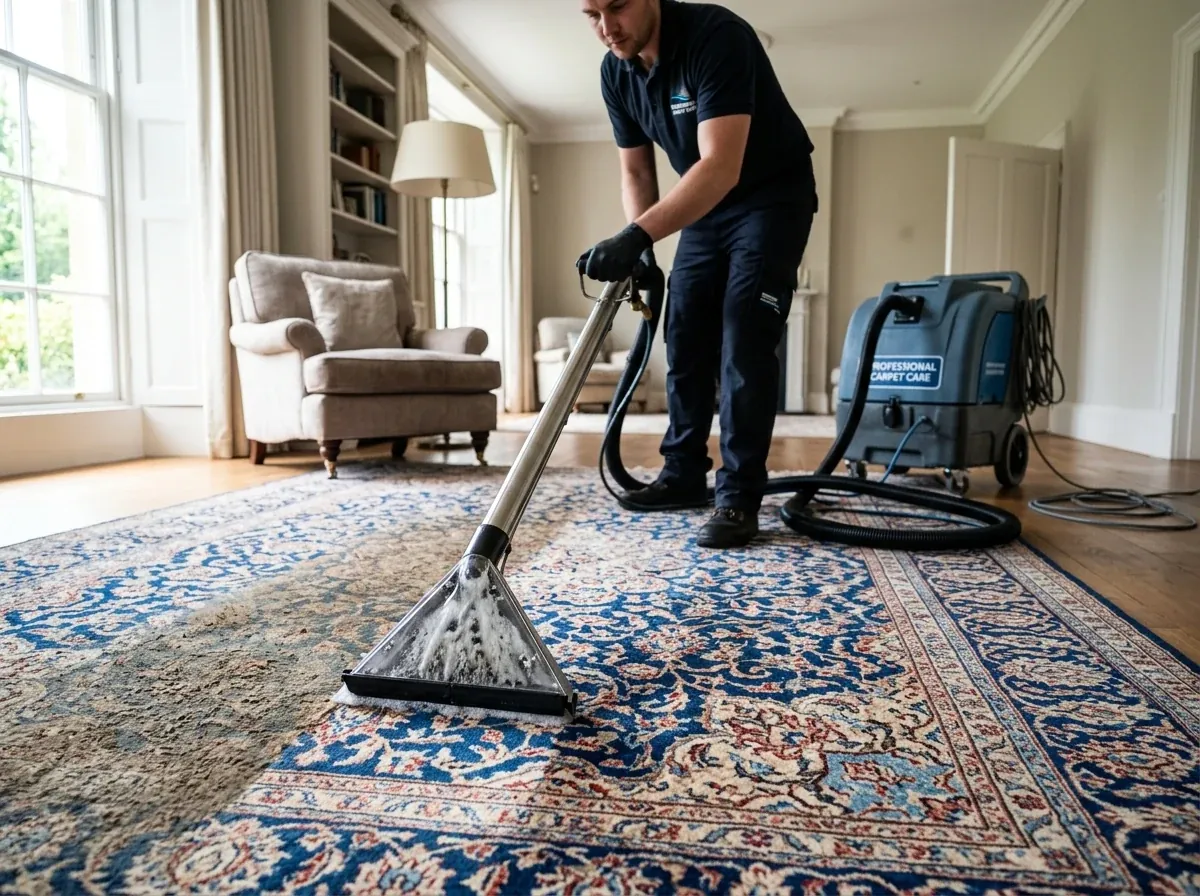
Biological carpet cleaning at home and on-site cleaning services serve demanding office rugs without any removal. The advanced injection-extraction method uses ecological hypoallergenic solutions, ensuring a deep on-site rug cleaning with 90% liquid recovery.
The on-site intervention is an ideal solution for cases where lifting and transporting the carpets is practically impossible or economically unviable. Using specialised portable high-power units, the cleaning takes place immediately at the customer’s premises, offering certified hygiene with minimal disruption to daily operations.
On-site rug cleaning in commercial spaces & homes
On-site rug cleaning with the injection-extraction method is the most effective solution for professional offices and homes. For businesses and residents who search for carpet cleaning services near me, our crews cover every neighbourhood of Thessaloniki — and when a full workshop wash is not required, on-site cleaning saves both time and money. Specialised professional equipment sprays the active solution under pressure while simultaneously vacuuming up the soiling, fully protecting the floor infrastructure. Prices for washing an office rug range between €2.50 and €4.50 per m². Drying time is limited to 3 to 6 hours, allowing the work to be done outside working hours or at weekends, without any interruption of business operations.
To speed up the drying process on large commercial surfaces, specialised crews use powerful axial-flow dryers (turbo air movers). These devices create a continuous laminar flow of air over the rug, reducing the required drying time to under 3 hours and allowing the immediate use of the office spaces.
Disinfection against mites, allergens and pathogenic microorganisms
Certified carpet disinfection eliminates up to 99.9% of bacteria and fungi. These microscopic allergens are linked to allergic reactions and respiratory irritation. Anti-allergenic carpet cleaning applies approved, hypoallergenic formulations with a neutral pH, making the space safe for families with small children and pets. Regular allergen neutralisation every 6 to 12 months prevents the accumulation of pathogenic microorganisms in the fibres and immediately improves the quality of the indoor air.
The application of micro-encapsulation technology binds the microparticles and allergens in crystalline form, making them easy to remove with subsequent regular vacuuming. In this way, a long-lasting protective barrier is created that prevents the multiplication of mites, ensuring a healthy microclimate in the living or working space.
A guide to proper carpet storage and care
Proper carpet storage and preventive care during the summer months safeguard the multi-year protection and durability of every weave. A specialised professional workshop offers safe facilities with stably controlled climatic conditions, preventing irreparable damage from moisture, dust and insects.
For effective anti-moth protection of carpets, the use of toxic naphthalene has been fully replaced by modern, odourless and hypoallergenic repellent sprays. The packaging requires special breathable carpet bags or perforated polyethylene with micro-holes, so that any internal moisture can escape. Fully hermetic sealing is strictly forbidden for woollen and silk threads, as the lack of natural ventilation favours the growth of fungi. In addition, a regular visual check of the packaging every 3 months is recommended.
The optimal carpet storage conditions require a stable temperature of 15°C to 22°C and a room relative humidity strictly below 55% to 60%. Unsuitable spaces, such as damp basements or uninsulated attics, should be avoided because of the high risk of mould and bad odours. Storing carpets in a horizontal position on raised shelves is mandatory to prevent permanent creases and deformation. Finally, the complete avoidance of direct solar radiation keeps the brightness of the colours unaltered.
When preparing for storage at home, the carpet must always be rolled tightly, strictly following the direction of the pile, and never folded in four. Folding creates permanent pressure lines that break the warp and destroy the elasticity of the fibres, making a full recovery of the carpet onto the floor impossible.
The use of an inner hard-cardboard cylinder when rolling is also recommended, providing a stable axis of support and preventing the carpet from bending under its own weight. If storage is in a household cupboard, the roll should be laid flat and never stood upright on its ends, as continuous pressure on the fringes and the side edges causes irreversible deformation.
How to choose the right carpet-cleaning workshop & the booking process
Finding a reliable carpet-cleaning workshop requires checking certifications and pricing transparency. A specialised professional workshop offers online carpet-cleaning appointments and an insurance guarantee.
Choosing the right professional protects your property and ensures your carpets receive the appropriate treatment according to international cleaning specifications. Assessing the facilities, the staff’s experience and the guarantees offered is the safest guide for any consumer.
Selection criteria: insurance guarantee, certifications and reviews
The basic criteria for choosing a reliable carpet-cleaning workshop include full insurance coverage, international certifications and transparent documentation. Every certified company offers a guarantee and a public liability insurance policy against risks of damage, theft or loss — ask to see it in writing. At the same time, the ISO 9001 standard ensures quality control, while ISO 14001 guarantees the use of ecological cleaners with a neutral pH. The official receipt records the dimensions, the pile and pre-existing damage in detail, providing legal protection. Finally, high ratings on independent platforms deter the assignment to unauthorised crews.
The technological infrastructure for tracking the carpets also plays a significant role, such as the use of unique barcodes or RFID tags on every item collected. This system excludes the possibility of loss or mix-up during the washing and storage stages, while allowing the customer to be digitally informed of the progress of their order in real time.
Order process, pick-up appointment and delivery time (5-7 days)
The service process is completed simply through a telephone or online appointment, with free pick-up and home delivery. The usual delivery time ranges from 5 to 7 working days, ensuring immediate, safe and excellent care for every type of carpet.
Upon the arrival of the specialised driver at your premises, a first on-site assessment and measurement of the dimensions takes place, in the customer’s presence. A copy of the receipt is issued immediately with a detailed description of each carpet, so there is full transparency as to the final charge and the agreed work.
At the scheduled delivery, the carpets are returned clean, disinfected and packaged in special protective nylon, ready either for immediate laying or for storage. It is recommended that you check the external condition of the packaging and confirm that the contents correspond exactly to the details of the original receipt.
Frequently asked questions
How much does carpet cleaning cost per square metre in Thessaloniki?
Machine-made synthetic carpets are cleaned from €3.50–5.00 per m², woollen ones from €4.50–7.00/m² and handmade or silk carpets from €6.00–10.00/m², including safe summer storage.
What is the difference between cleaning a handmade and a machine-made carpet?
Handmade pieces (Persian, Bukhara, Ziegler) are cleaned exclusively with dry organic foam and controlled gentle methods, as the rotary machine destroys the hand-tied knots. Shaggy and machine-made carpets withstand deep wet cleaning with the injection-extraction method.
Can I wash the carpet on the balcony?
It is not recommended — without industrial spin-drying the moisture is trapped in the base and causes mould and rot, while the sun yellows and fades the fabric. The cost of restoration far exceeds the professional workshop’s price.
How is a carpet properly stored in summer?
In breathable micro-perforated packaging, in a horizontal position on raised shelves, at 15–22 °C and relative humidity below 55%. Traditional naphthalene has been replaced by odourless, hypoallergentic anti-moth repellent sprays.
How long does the workshop service take?
Pick-up and home delivery are free and the usual turnaround is 5–7 working days. Every order comes with an official receipt with a detailed description of each carpet, its dimensions and any pre-existing damage.