Services
Sofa & Upholstery Cleaning
Deep cleaning of sofas, armchairs and mattresses with certified biological products — safe for children and pets. We remove stains, odours and dust mites.
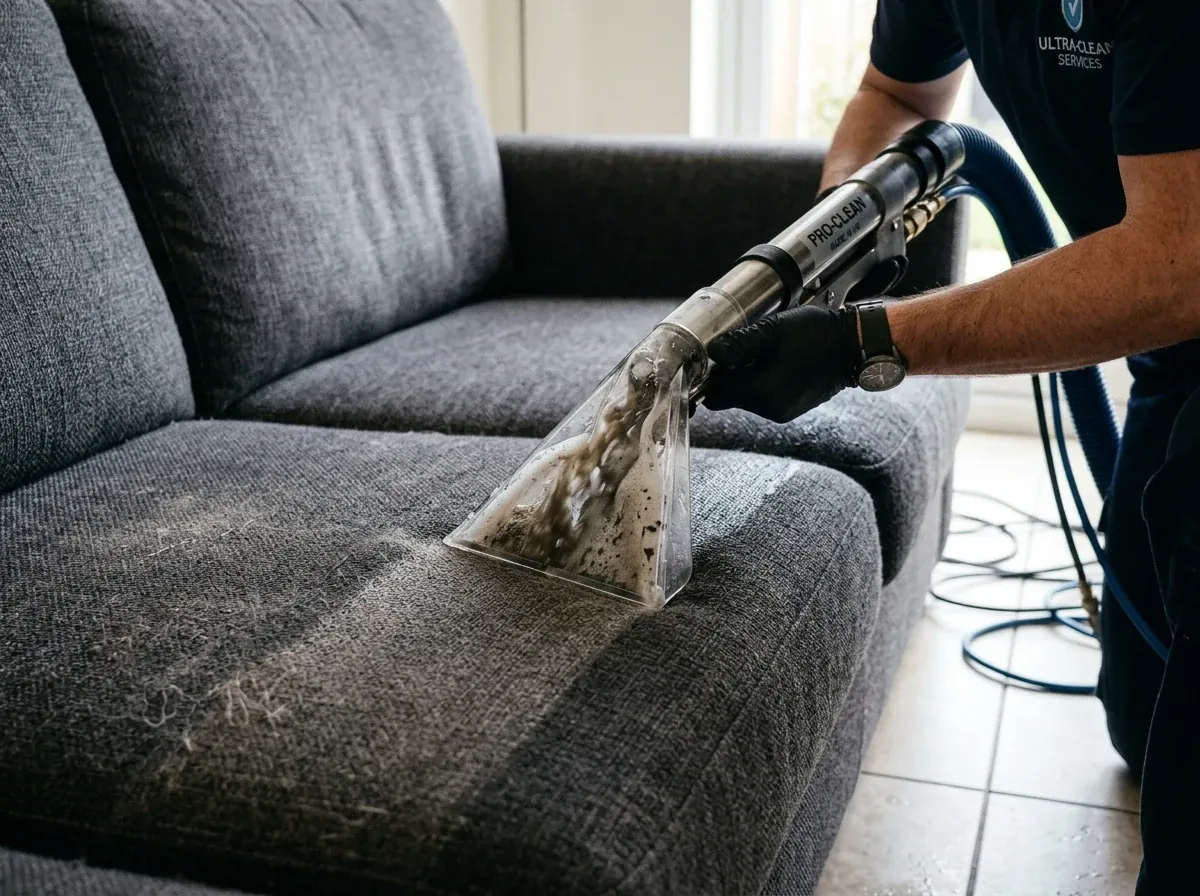
What is biological sofa cleaning and why is it necessary?
SKG Clean is a sofa cleaning service for homes and businesses in Thessaloniki: steam cleaning services and biological deep cleaning for sofas, armchairs and any upholstery cleaning service need — all done on site, without moving your furniture. Professional biological sofa cleaning is a specialised deep-sanitation procedure, essential for the hygiene of indoor spaces. Using modern extraction equipment, mites and allergens are removed at depth, ensuring a healthy living environment without toxic residue.
Key highlights
- Deep cleaning: Washes foam core up to 8–12 cm deep, removing 99.9% of mites.
- Affordable prices: A standard 3-seater sofa costs between €35 and €45.
- Quick process: Cleaning takes only 45 to 90 minutes per piece of furniture.
- Fast drying: Industrial extraction leaves furniture dry in just 3 to 6 hours.
- Safe materials: Uses ecological, biodegradable solutions safe for kids and pets.
The difference between simple surface cleaning and deep bio-cleaning
The essential difference between simple surface cleaning and professional deep bio-cleaning lies in the depth of action and the effectiveness of eliminating microbial loads. A household vacuum removes barely 10–15% of surface soiling, unable to lift the accumulated pollen and dust. What is more, common sprays leave detergent residue that acts as a dirt magnet.
By contrast, the professional extraction method washes the foam core to a depth of 8–12 cm, fully neutralising pathogenic microorganisms.
| Parameter | Simple cleaning | Deep bio-cleaning |
|---|---|---|
| Depth of action | 1–2 mm | Up to 8–12 cm |
| Mite removal | 10–15% | Up to 99.9% |
| Chemical residue | Sticky soap | Zero residue |
| Fabric protection | Surface wear | Full sanitation |
Micro-splitting technology and ecological chemical-free cleaners
The pioneering Micro-splitting technology has revolutionised professional cleaning, breaking dirt molecules down into microscopic particles without a trace of aggressive chemical agents. The ecological biodegradable water-based solutions contain no surfactants, synthetic bleaches, enzymes or volatile organic compounds (VOCs), while simultaneously reducing water and energy waste.
The international Woolsafe and Dermatest certifications guarantee absolute hypoallergenic protection for sensitive groups, infants and pets. At the same time, the specialised formulations are fully compatible with delicate fabrics such as linen, cotton, chenille, nubuck and microfibre, keeping the original texture and colour brightness unaltered.
How much does biological sofa cleaning cost in 2026 (a detailed price list)
In the Greek cleaning market for 2026, the cost of a biological sofa cleaning is determined by the layout and the additional work. The minimum call-out charge usually comes to €35 to €45, fully covering the crew’s travel expenses.
Prices per seat and type of furniture (two-seater, three-seater, corner)
The final price depends directly on the layout and the number of seats of the piece, with specialised crews offering packages tailored to every type of sofa. A flat unified pricing applies to fabrics such as microfibre, jacquard or chenille, while genuine leather requires extra conditioning. The cleaning takes 45 to 90 minutes, while drying time ranges at 3 to 6 hours.
| Type of furniture | Number of seats | Average price (€) | Duration of work |
|---|---|---|---|
| Armchair | 1 seat | €15 - €20 | 30 - 40 minutes |
| Two-seater sofa | 2 seats | €25 - €35 | 45 - 60 minutes |
| Three-seater sofa | 3 seats | €35 - €45 | 60 - 75 minutes |
| Corner sofa | 4 - 5 seats | €50 - €70 | 75 - 90 minutes |
Step by step: how professional biological cleaning is done at home
The complete sofa-cleaning process at home is based on a strict protocol of hygiene and protection of the space. Professional sofa cleaning at home is carried out in successive technical stages, ensuring certified disinfection and the complete removal of pathogens.
Stage 1: Deep vacuuming, dust agitation and mite removal
The first and most fundamental stage of bio-cleaning is dry deep vacuuming with specialised vibration and filtration equipment. Special pulsating heads pulverise the dust in the sofa, breaking down the compact layers of soiling inside the foam core to a depth of 10 to 15 centimetres.
The process achieves the complete removal of allergens from the sofa, neutralising Dermatophagoides pteronyssinus mites and their droppings. Vacuuming with a professional H13 or H14 class HEPA vacuum binds 99.95% of microparticles down to 0.3 microns in size, preventing their dispersal. This deep foam-core cleaning removes dead epithelial cells, preparing the fibre perfectly for the wet stage.
Stage 2: Spraying the ecological solution & extraction (injection-vacuuming)
In the second stage, micro-splitting technology is combined with the injection-extraction method for the definitive removal of soiling. The ecological soap-free solutions break the dirt molecules down into microscopic particles, eliminating residue without chemical remains.
Professional extraction machines deliver the liquid at a pressure of 4 to 9 bar. At the same time, the modern fabric washing-extraction machine immediately vacuums up over 90% of the water into the waste tank. The certified injection-extraction process prevents mould from developing in the sofa, reducing water waste in every professional sofa application. Absolute cleanliness is thus ensured.
Stage 3: Specialised spot removal of stubborn stains (spotting)
The spot removal of stubborn stains (spotting) is the most demanding stage of the process, as it requires an accurate diagnosis of the chemical composition of each type of soiling. Specialised sofa stain removers with a buffered pH are applied locally according to international upholstery cleaning standards.
Enzymatic cleaners break down protein stains from blood or milk, while special solutions tackle tannin and greasy stains from coffee or oil. Before removing difficult sofa stains, every solution is tested on an inconspicuous spot of the upholstery. With soft brushes, effective spotting of furniture fabrics is achieved without damage to the delicate fibres.
Drying time and instructions for use after the cleaning
The full restoration and drying of fabric furniture after a professional bio-cleaning takes on average 3 to 6 hours, depending on the fabric and the ambient humidity. The powerful extraction machines remove 90% to 95% of the moisture, preventing the growth of fungi and mould.
In Thessaloniki’s dry summer climate, barely 2 to 4 hours are needed, while in periods of high relative humidity the time reaches 6 hours. With modern radial dryers, the drying time of a biological cleaning is significantly reduced. For a faster result, drying the sofa with an air conditioner speeds up its safe use.
Dealing with special problems and material peculiarities
Managing stubborn organic stains on demanding surfaces calls for targeted cleaning protocols for each type of furniture. The different categories of fabrics and delicate materials react uniquely to organic soiling, making an individualised technical approach necessary.
Cleaning pet stains (urine, hair) and neutralising odours
Neutralising organic pet soiling requires a specialised bio-enzymatic intervention and not simple surface cleaning. Household folk remedies, such as vinegar or baking soda, crystallise uric acid, worsening the odour in the high summer temperatures.
The professional process begins with a deep vacuuming of hair through HEPA H14 filters and continues with the application of specialised enzymatic neutralising formulations. With micro-splitting technology, the protein and thiol molecules are broken down into harmless substances. These ecological enzymatic solutions eliminate odours while remaining absolutely safe for dogs and cats.
Fabric vs leather sofas & delicate materials (alcantara, velvet)
The choice of cleaning technique is strictly determined by the structure of the material, as natural leather and luxury fabrics such as velvet require radically different treatment. While synthetic fabrics are cleaned with wet extraction, genuine leather excludes excess water and requires a pH-neutral cleaning foam.
According to international standards, leather is conditioned with special wax creams to prevent cracking in the dry Greek summer. Similarly, on alcantara and velvet a low-moisture dry foam and pile revival are applied, maintaining the elasticity and original colour of the fibres without thermal stress.
Disinfection against mites, fungi and protection from allergies
The accumulation of dust mites and fungi inside fabrics is one of the main causes of allergic flare-ups in the home. In the humid climate of coastal areas, Dermatophagoides pteronyssinus mites multiply rapidly inside the polyurethane foam.
Micro-splitting technology deactivates protein allergens without toxic chemicals, while powerful vacuum systems with HEPA H14 filters capture 99.97% of particles from 0.3 microns in size. For the effective prevention of allergic rhinitis and asthma, a certified deep bio-cleaning at least twice a year is recommended.
Professional bio-cleaning vs DIY household cleaning
The difference between professional and household sofa cleaning is determined by the technology and the safety of the materials. Professional spray-extraction equipment and micro-splitting ecological solutions replace the empirical DIY methods with soda or vinegar, offering certified disinfection.
Why a household steam cleaner and common sprays can destroy the fabric
The uncontrolled use of hot steam and common cleaning foams is one of the most frequent causes of irreversible damage to furniture fibres. A household steam cleaner without strong suction emits temperatures above 100°C, causing the immediate coagulation of protein stains from sweat or food, permanently setting them into the fabric. At the same time, the chemical residue of surfactants from common sprays creates a sticky layer of rapid re-soiling.
Inside the foam core, trapped moisture in Greek summer conditions above 30°C favours the growth of mould colonies within 48 hours. Delicate materials such as velvet or chenille suffer thermal alteration with no possibility of restoration.
Renting an extraction machine vs hiring a professional: what pays off?
Although renting an extraction-type washing machine may seem an economical solution, factoring in the hidden costs and the effort often overturns the equation. The daily cost of renting a device ranges at €25–35, with an additional €10–15 for certified detergents and a deposit. On the other side, the complete service from a specialised cleaning crew starts from €45–50 in 2026, including full disinfection.
Technologically, rented equipment operates at a low pressure of 1–2 bar with limited airflow, extending the drying to 3–4 days. Industrial extraction machines deliver up to 9 bar, ensuring immediate moisture absorption and safe use of the sofa within 3–6 hours.
Frequently asked questions
How much does biological sofa cleaning cost in 2026?
The minimum call-out charge comes to €35–45, a two-seater sofa costs €25–35, a three-seater €35–45 and a corner sofa €50–70. The work takes 45–90 minutes per piece of furniture.
How long does the fabric take to dry after cleaning?
Professional extraction machines remove 90–95% of the moisture and full drying is completed in 3–6 hours, depending on the fabric and the ambient humidity. With radial dryers the time is significantly reduced.
Is the method safe for children and pets?
Yes — the hypoallergenic biodegradable solutions with Woolsafe and Dermatest certifications neutralise 99.99% of bacteria and mites without toxic residue or irritating fumes.
Can I clean the sofa myself?
A household steam cleaner without strong suction coagulates protein stains and sets them permanently, while the moisture trapped in the foam core favours mould growth within 48 hours. Renting a machine costs €25–35 a day — as much as a professional application with industrial equipment.
How often is a deep bio-cleaning needed?
For everyday furniture a deep biological cleaning once every six months is enough. In homes with pets, small children or allergy sufferers it is recommended quarterly, especially before the summer and winter seasons.